
Birth Certificate Translation Services in India : Step-by-Step Guide
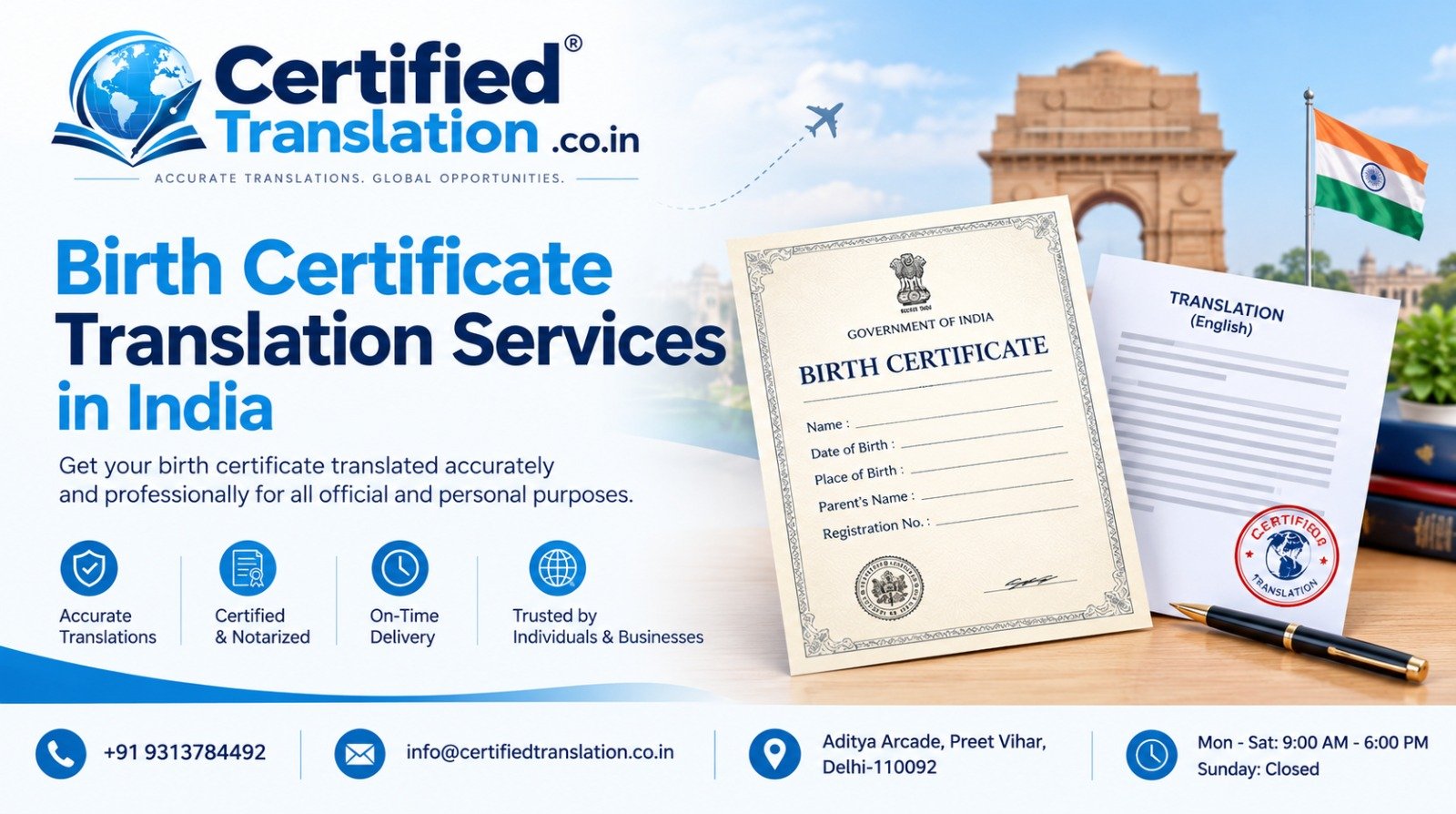
A birth certificate is one of the most important personal documents because it records essential information about an individual's birth, including their name, date of birth, place of birth, and parent details. This document is commonly required for immigration, education, employment, citizenship applications, family visas, and several other official procedures. When a birth certificate is issued in a language that the receiving authority does not understand, an accurate translation may be necessary.
Birth Certificate Translation Services in India help individuals convert birth records into another language while preserving the original information, spelling, dates, and official details. Depending on the purpose, applicants may require a certified translation, a translator's declaration, notarization, or additional document authentication. The exact requirements depend on the receiving institution and destination country.
People planning to study abroad, relocate with their families, apply for foreign citizenship, or submit legal paperwork may need professional assistance to prepare an accurate translated birth certificate. Understanding the translation process beforehand can help reduce errors, avoid unnecessary delays, and ensure that the document is prepared according to the requirements communicated by the concerned authority.
What Are Birth Certificate Translation Services?
Birth certificate translation involves converting the information recorded on an original birth certificate into another language without changing its meaning. The translator must preserve all essential details, including the individual's full name, date of birth, gender, place of birth, parents' names, registration number, issuing authority, and relevant stamps or annotations.
Professional birth certificate translation services in India are useful when documents issued in Hindi, Bengali, Tamil, Telugu, Marathi, Gujarati, Kannada, Malayalam, Punjabi, or another Indian language need to be translated into English or a foreign language.
Similarly, an English birth certificate may require translation into German, French, Spanish, Italian, Portuguese, Japanese, Arabic, Russian, Dutch, or another language. The correct language combination depends on the institution receiving the document.
For example, an applicant submitting family immigration documents to a German authority may need a German translation, whereas a university or government office in another country may request English. Professional translators help maintain consistency between the original record and the translated version.
Applicants looking for certified birth certificate translation services in India should first determine whether the receiving organisation accepts a standard translation or requires a certified version prepared by a qualified translator.
Why Is Birth Certificate Translation Important?
Birth certificates serve as evidence of personal identity and birth details. However, a document issued in one language may not be immediately understandable to a foreign government office, educational institution, court, or immigration department.
A professional translation makes the information accessible to the recipient while maintaining the meaning of the original record. It can also help prevent confusion caused by unfamiliar scripts, different date formats, abbreviations, and variations in personal names.
For individuals applying for a visa, an accurate birth certificate translation for immigration may be necessary when the authority requests translated civil-status documents. Applicants should always check the document checklist provided for their specific visa category.
Translation can also be important for people who need to establish family relationships, submit applications for foreign citizenship, enrol children in schools, or complete legal formalities outside India. An appropriately prepared document can help the reviewing authority understand the recorded information more easily.
Common Situations That Require Birth Certificate Translation
1. Immigration and Family Visa Applications
Birth certificates are frequently requested during family-based immigration procedures. They may help establish the relationship between parents and children or support applications involving dependent family members.
Someone applying for a family visa may need a birth certificate translation for visa application purposes. The destination country's immigration authority determines whether certification, a specific translator declaration, or additional authentication is necessary.
Applicants in Delhi preparing overseas immigration paperwork may search for birth certificate translation in Delhi, while families in Noida may require certified translation of birth records for a dependent visa. Residents of Ghaziabad might need translated documents for a family sponsorship application, and applicants in Gurugram may need the same service while preparing a relocation file.
In Faridabad, translated birth records can also be relevant to family documentation submitted to overseas authorities. In each case, the translation should accurately reproduce the original information rather than modify or interpret the details.
2. Foreign Citizenship and Permanent Residency
People applying for foreign citizenship or permanent residency may be asked to submit civil-status documents. A translated birth record can help the reviewing authority verify personal details and family relationships.
Applicants should check whether the receiving authority requires a certified translation of a birth certificate and whether the translation must follow a prescribed format.
Individuals searching for birth certificate translation services in Mumbai may need translated records for permanent residency paperwork. Families in Navi Mumbai may require English-to-French or Indian-language-to-English translation, depending on the country concerned. Applicants in Thane may need translation for a citizenship application, while residents of Pune may submit translated birth certificates as part of a family immigration file.
For people in Nagpur, Nashik, and Chhatrapati Sambhajinagar, the appropriate language and certification requirements will similarly depend on the receiving authority. Selecting the correct service at the beginning helps applicants prepare documents more efficiently.
3. Education and School Admissions
Some international schools, colleges, and universities request birth certificates to verify age or personal details. This is particularly relevant when children move abroad with their families or apply for admission to institutions that require translated records.
Parents looking for birth certificate translation for school admission should confirm whether the school accepts a standard English translation or requires formal certification.
Families in Bengaluru may need birth certificate translation services in Bengaluru for international school enrolment, while parents in Mysuru may require translated birth records for an overseas education application. Residents of Chennai could need certified translation for admission paperwork, and families in Coimbatore may require a translated document when registering children at a foreign educational institution.
In Hyderabad, translated birth records may support university-related family paperwork. Applicants in Visakhapatnam and Vijayawada may also need the document when preparing school, guardianship, or immigration applications.
4. Court Cases and Legal Procedures
Birth certificates can be relevant to inheritance matters, family disputes, guardianship proceedings, adoption-related documentation, and other legal processes. When a court or legal professional requests a translation, the required format may be different from the format accepted for general administrative purposes.
A person seeking legal translation of a birth certificate should explain the document's intended use before placing the order. Some proceedings may require a translator's declaration, notarization, or another formal procedure, but these requirements should not be assumed to apply universally.
Applicants in Kolkata may need a translated birth record for court-related documentation, while individuals in Howrah may require translation for a family legal matter. In Siliguri, such services may be useful for documents intended for use outside India. Residents of Bhubaneswar and Cuttack may also require professionally translated civil records when handling legal or administrative applications.
Languages Available for Birth Certificate Translation
India's linguistic diversity means that birth certificates may be issued in many different languages and scripts. The appropriate translation depends on the original document and the requirements of the destination authority.
Indian Language Translation
Birth records issued in Hindi, Bengali, Marathi, Gujarati, Tamil, Telugu, Kannada, Malayalam, Punjabi, Odia, Assamese, Urdu, and other languages may require translation into English or another language.
An applicant searching for Hindi birth certificate translation services in India may need assistance with a record issued by a local registration authority. Similarly, a person requiring Bengali birth certificate translation should ensure that names and registration details are reproduced accurately.
Marathi birth certificate translation may be necessary for documents intended for an English-speaking institution. Tamil birth certificate translation and Telugu birth certificate translation services in India can help individuals prepare regional-language records for international submissions.
Gujarati birth certificate translation, Kannada birth certificate translation, and Malayalam birth certificate translation are also relevant when documents must be understood by an authority that does not accept the original language.
Foreign Language Translation
Some applicants need their Indian birth certificates translated into the official language of another country. Others may have foreign birth certificates that need translation into English or an Indian language.
For example, English to German birth certificate translation services in India may be required for a German-language submission, subject to the receiving authority's rules. French birth certificate translation may be relevant to French-language documentation, while Spanish birth certificate translation can support applications involving Spanish-speaking institutions.
Italian, Portuguese, Dutch, Russian, Japanese, Arabic, Chinese, and Korean translation may also be required in specific circumstances. Applicants should identify the destination country and confirm the accepted language before requesting the service.
Residents of Ahmedabad may require a foreign-language translation for an overseas application, while applicants in Surat might need an English version of a regional-language document. In Vadodara and Rajkot, the appropriate translation can similarly depend on whether the record is intended for education, immigration, employment, or legal use.
How Does the Birth Certificate Translation Process Work?
A professional translation Services in India process generally involves several stages. The exact steps can differ according to the language combination, document format, and intended use.
Step 1: Share the Birth Certificate
The first stage involves providing a clear copy or scan of the original birth certificate. All pages, stamps, seals, signatures, registration numbers, and annotations should be visible.
A translation provider may ask whether the document is intended for a visa, court, school, passport-related procedure, citizenship application, or another purpose. This information helps determine the appropriate translation format.
- For example, applicants looking for online birth certificate translation services in Jaipur can share the document electronically if the provider accepts digital submissions. Residents of Jodhpur and Udaipur may also be able to enquire remotely, subject to the provider's service arrangements.
Step 2: Confirm the Target Language
The target language should be confirmed before translation begins. Applicants should not assume that English is accepted by every foreign institution.
For example, a document intended for a French-language authority may require French, while another office may specifically request English. The receiving authority's written instructions should take priority over general assumptions.
People searching for birth certificate translation in Lucknow should confirm the language needed for the relevant application. Applicants in Kanpur may require translation for overseas employment or family relocation, while residents of Agra and Varanasi may need documents translated for academic or citizenship procedures.
Step 3: Translate the Information Accurately
The translator examines the document and converts its content into the required language. The objective is to preserve the information exactly as recorded, not to alter names, correct personal details without authorisation, or change the meaning of official remarks.
Particular attention should be given to transliteration, spelling, date formats, place names, and administrative terminology. If a name appears differently across documents, the translator should not independently decide which version is legally correct.
An applicant seeking birth certificate translation in Prayagraj should provide any relevant spelling guidance if the receiving authority has specified a preferred format. Similar care is important for applicants in Meerut and Aligarh who are preparing multiple identity documents for one application.
Step 4: Review Names, Dates, and Registration Details
Quality checking is a crucial part of the process. Before finalising the translated document, the translator should compare important details against the original.
This review may include the individual's name, parents' names, birth date, place of birth, registration date, issuing office, and certificate number. Any handwritten entry or unclear field should be handled carefully rather than guessed.
People requesting birth certificate translation services in Chandigarh may wish to check the translated copy against their passport or other identity documents. Applicants in Mohali and Panchkula should likewise verify the spelling of names and the order of dates, especially when several documents are being submitted together.
Step 5: Prepare Certification, If Required
A certified translation usually includes a statement or declaration confirming that the translation is accurate and complete, together with information identifying the translator or translation service where applicable.
However, the term “certified translation” does not have a single universal meaning across all countries and institutions. Some authorities specify the translator's qualifications, wording of the certification statement, signature requirements, or an approved translation process.
Before ordering a certified birth certificate translation, applicants should confirm the receiving authority's rules. People in Dehradun may need certification for an overseas application, while applicants in Haridwar or Roorkee may have different requirements depending on the destination country and the organisation reviewing the document.
Step 6: Arrange Notarization or Authentication if Necessary
Translation, notarization, attestation, and apostille are different procedures. A translated document does not automatically receive legal authentication merely because a professional has translated it.
India's Ministry of External Affairs explains that apostille is available for personal documents, including birth certificates, and distinguishes apostille from normal attestation for countries where apostille is not accepted. The relevant authentication requirements should be checked for the specific document and destination.
Applicants searching for birth certificate services should first establish whether an apostille is needed and whether the issuing document must undergo state-level authentication. Not every translation requires notarization or an apostille, and not every authority accepts the same combination of procedures.
Documents and Information Needed for Translation
The principal requirement is usually a clear copy of the birth certificate. Depending on the service provider and the purpose of the translation, additional information may help establish the correct format.
Applicants may be asked to provide the target language, destination country, name-spelling preferences consistent with existing official records, and the instructions issued by the organisation receiving the document.
If the certificate is damaged, incomplete, or difficult to read, a clearer copy may be required. A translator should not invent missing information or silently replace an unclear entry with an assumed detail.
In Bhopal, applicants may request translation of a civil birth record for an overseas application. Residents of Indore may need translated documents for family immigration, while people in Jabalpur could require translation for education or legal paperwork. Similar support may be useful in Raipur and Ranchi, depending on individual requirements.
Applicants should share only the information necessary to complete the service and use an appropriate, secure channel when submitting personal documents.
Important Details That Should Not Be Changed During Translation
A birth certificate contains personal information that must be reproduced carefully. Even a small discrepancy may create questions when the translated document is compared with a passport, visa application, or another official record.
Names should follow a consistent and appropriate transliteration method. Dates should be presented clearly, with care taken to avoid confusion between day-month-year and month-day-year formats. Places of birth and issuing authorities should be rendered accurately, and registration numbers should remain unchanged.
If a certificate contains abbreviations, stamps, handwritten notes, or corrections, the translator should handle them according to their context and the requested format. An illegible field should not be guessed.
Applicants looking for birth certificate translation in Patna should review their final document for consistency with other records. People in Guwahati and Shillong may also need to verify name spellings and dates before submission, especially when the translated certificate forms part of a larger application.
How to Choose the Right Translation Service Provider
Choosing a translation provider involves more than comparing prices. Applicants should evaluate the provider's language expertise, experience with civil documents, quality-review practices, data-handling procedures, and ability to follow the receiving authority's instructions.
A reliable provider should explain what the quoted service includes. For instance, a basic translation may not include certification, notarization, courier delivery, or authentication fees. Knowing the scope of work before placing an order helps avoid misunderstandings.
Applicants searching for professional birth certificate translation services in India should ask whether the translation will include all visible text and relevant official markings. They should also ask how unclear details will be handled and whether corrections can be made if a translation error is identified.
Residents of Kochi may require translation for family relocation, while applicants in Thiruvananthapuram may need civil documents prepared for a foreign authority. People in Kozhikode and Thrissur may also benefit from checking the target authority's certification instructions before choosing a provider.
For applicants in Mangaluru, Mysuru, or Hubballi, the same principle applies: select the service based on the document's intended use rather than assuming that every translation format is accepted everywhere.
Online Birth Certificate Translation Services in India
Online translation services can make the process more convenient for applicants who cannot visit an office in person. Depending on the provider, the document may be submitted through email, an online form, or another designated channel.
A typical online workflow includes sharing a scan, confirming the language, receiving a price quotation, approving the order, and receiving the completed translation electronically or in another agreed format.
Applicants searching for online birth certificate translation in India should check whether a digital copy is sufficient or whether an original signed or printed version is required. Some institutions accept electronic documents, whereas others may require a signed paper copy or a prescribed submission method.
Online services can be useful for individuals based in Panaji, Margao, Imphal, Agartala, Aizawl, Itanagar, Kohima, Gangtok, and other locations where travelling to a specialist translation office may be inconvenient. Availability, delivery options, and applicable certification arrangements should always be confirmed with the provider.
Birth Certificate Translation for Different Countries
Translation requirements differ according to the country, institution, and purpose for which the document will be used. An authority may specify the required language, certification statement, translator qualifications, or additional authentication steps.
For a submission to Germany, applicants should check whether the authority requires a German translation prepared under particular rules. For France, the receiving organisation may specify an accepted translator or certification format. Similar verification is advisable for applications involving Spain, Italy, Portugal, the Netherlands, Belgium, Austria, Switzerland, Norway, Sweden, Finland, Canada, the United Kingdom, Australia, Japan, and the United States.
The language alone does not determine whether a document will be accepted. A professionally prepared English translation, for example, may still need a particular certification format if the receiving authority says so.
People applying from Ahmedabad, Bengaluru, Chennai, Mumbai, Delhi, Hyderabad, or any other Indian city should follow the same principle: check the requirements of the actual receiving organisation before ordering translation or authentication.
Common Mistakes to Avoid
One frequent mistake is ordering a translation before confirming the accepted language. Another is assuming that a notarized translation, certified translation, and apostilled document are interchangeable. They are not necessarily equivalent, and each procedure serves a different purpose.
Applicants should also avoid submitting blurry scans, overlooking handwritten corrections, or allowing different spellings of the same name to go unnoticed. Incorrect date formatting and incomplete translation of stamps or annotations can also create difficulties during document review.
A further mistake is relying on general advice without checking current requirements. The rules for a university may differ from those of an immigration department, court, embassy, or civil registry.
Before submitting a translated birth certificate, applicants should confirm the required format, review all personal details, and retain a copy of the translation and relevant order information.
Benefits of Professional Birth Certificate Translation
Professional translation can help improve the clarity and consistency of personal documents. An experienced translator understands that civil records require careful treatment of dates, names, administrative terminology, registration details, and official notes.
A structured review process can reduce avoidable errors. Clear communication about certification requirements can also help applicants understand what is included in the service and what must be arranged separately.
For families preparing several documents, using a consistent translation approach can make it easier to compare names and personal details across records. Professional support may also save time for applicants who are unfamiliar with the target language or the receiving authority's document format.
However, no translation provider can guarantee that a government office, embassy, university, or court will approve an application. Final acceptance depends on the receiving authority's rules and its assessment of the submitted documents.
Frequently Asked Questions
1. What are Birth Certificate Translation Services in India?
These services translate a birth certificate from its original language into another language while preserving the recorded personal details. Depending on the intended use, applicants may also need a certified translation or an additional authentication procedure.
2. Why do I need a translated birth certificate?
A translated birth certificate may be required for immigration, citizenship, international school admission, family visas, court proceedings, or other official applications when the receiving organisation does not accept the original language.
3. Is a certified birth certificate translation always necessary?
No. The requirement depends on the receiving institution, destination country, and purpose of the application. Applicants should follow the specific document instructions provided by the relevant authority.
4. Can I order birth certificate translation online?
Many translation providers accept digital document submissions. However, applicants should check whether the receiving organisation accepts an electronic translation or requires a signed, printed, or otherwise formally certified version.
5. Is an apostille required after translating a birth certificate?
Not in every case. Translation and apostille are separate procedures. The need for an apostille or another form of attestation depends on the document, destination country, and receiving authority's requirements.
6. Which languages are available for birth certificate translation?
Possible language combinations include Indian languages and international languages such as English, German, French, Spanish, Italian, Arabic, Portuguese, Russian, Japanese, and Dutch. Availability should be confirmed with the selected translation provider.
7. How can I avoid mistakes in a translated birth certificate?
Provide a clear copy of the original document, confirm the target language, communicate any official name-spelling requirements, and carefully review names, dates, registration numbers, and other details before submission.
8. Will a translated birth certificate automatically be accepted abroad?
No. Acceptance depends on the receiving authority's requirements. It may request a particular certification format, additional authentication, or other supporting documents even when the translation itself is accurate.
Conclusion :
Birth certificates are essential personal records, and an accurate translation may be required when the document is submitted to an organisation that does not accept its original language. Whether the purpose is immigration, education, citizenship, family documentation, or a legal procedure, applicants should ensure that all personal details and official entries are reproduced correctly.
Birth Certificate Translation Services in India can support this process by preparing clear, carefully checked translations in the required language. Before placing an order, applicants should confirm whether the receiving authority requires certification, notarization, apostille, or another form of authentication.
By choosing an experienced provider, sharing a legible document, and checking the relevant submission rules, individuals can prepare their birth certificates more confidently and reduce the risk of errors during document review.
Contact Details
Website: https://www.certifiedTranslation services.co.in/
Phone: +91 9313784492
Email: info@certifiedTranslation services.co.in
Office Address: Aditya Arcade, Preet Vihar, Delhi – 110092
Working Hours: Monday to Saturday, 9:00 AM–6:00 PM. Closed on Sundays.
When requesting a quotation, provide the source language, required target language, document type, number of pages, intended use, and deadline. This information can help the team assess the assignment and explain the available options.